
Palm reading (hasta samudrika) reads the lines, mounts and shape of the hands to describe temperament, health tendencies, relationships and the timing of major changes.
It is particularly useful where a birth time is unknown and a full chart cannot be cast. Vijay Ram reads palms in person at 33 New Broadway, Ealing, London, and from clear photographs sent over WhatsApp.
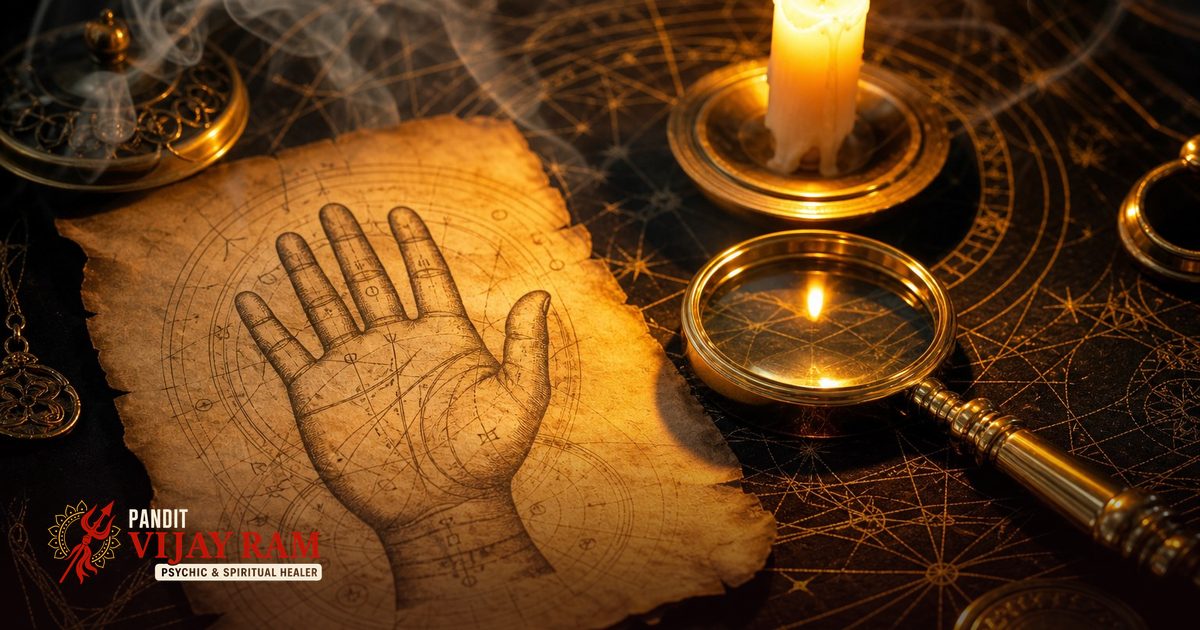
What the hand is read for
| Feature | What it describes |
|---|---|
| Heart line | How you attach — guarded or open, steady or intense |
| Head line | How you think and decide; where the caution or the recklessness sits |
| Life line | Vitality, constitution and major changes of direction — not lifespan |
| Fate line | Career direction, and how much of it is chosen versus inherited |
| Mounts | Which planetary energies dominate the temperament |
| Hand shape and fingers | Elemental type, working style, patience or its absence |
| Marks and crosses | Points of stress and points of protection |
The life line myth
A short life line does not mean a short life. It never has. The correlation was popularised in the nineteenth century and has caused an enormous amount of pointless fear since. What the life line actually describes is constitution, energy and the major redirections of a life.
Nobody is told how long they will live in this consulting room, from a palm or from anything else.
Reading from photographs
Perfectly workable, and used constantly for clients outside London. What is needed:
- Both palms, photographed separately.
- Natural daylight, near a window — no flash, which flattens the lines out of existence.
- Fingers slightly apart, hand relaxed rather than stretched flat.
- Close enough that the fine lines are visible when you zoom in.
- One photograph of the back of each hand as well, for the nails and the finger shape.
Fingers, nails and the shape of the hand
The lines get the attention, but a good deal of a reading sits in the structure of the hand itself, which changes far more slowly and describes the underlying constitution.
| Feature | Traditionally read as |
|---|---|
| Square palm, short fingers | Practical, direct, happier doing than deliberating |
| Long palm, long fingers | Analytical and sensitive; prone to overthinking a decision |
| Thumb angle and flexibility | Willpower, and how readily a person yields under pressure |
| Space between the fingers | Openness; tightly held fingers read as guardedness |
| Nail shape and condition | Constitution and, in the older texts, points of physical strain |
| Flexibility of the hand | Adaptability — a rigid hand and a rigid temperament often travel together |
Where the nails suggest something worth attention, you are told to see your GP. Nothing is diagnosed from a hand.
What is refused in a palm reading
- No lifespan. Not from the life line, not from anything else. The short life line myth is a nineteenth-century invention and it has frightened people for no reason ever since.
- No medical diagnosis. Marks on a hand are not evidence of disease. If something suggests attention to health, the advice is a doctor.
- No readings of a child’s future. Temperament and disposition in general terms only, with a parent present.
- No reading a third party’s hand from a photograph sent without their knowledge.
Palm reading with the chart
Where a birth time is known, the palm is read as a cross-check rather than as the primary instrument — a chart is a far more precise tool for timing. Where the birth time is not known, the palm carries the reading, and known life events can sometimes be used to rectify the birth time afterwards.
A reading describes tendencies and timing; it does not predict fixed events and it is not medical, legal or financial advice. You will be told plainly when a chart does not support a conclusion. No outcome is guaranteed.
Frequently asked questions
Which hand do you read?
Both. The non-dominant hand shows the inherited pattern and the disposition you started with; the dominant hand shows what has been made of it. The difference between the two is usually the most interesting part of the reading.
Do palm lines really change?
Yes, noticeably over five to ten years, particularly the head and fate lines. That is one of the more encouraging findings in the discipline.
Can you read a child's palm?
Only in general terms of temperament and disposition, with a parent present. No predictions are made about a child's future.
How long does a palm reading take?
Around forty-five minutes in person. A reading from photographs is returned within two to three days once clear images arrive.
Can you read my palm over WhatsApp?
Yes, from photographs — both palms separately in natural daylight near a window, no flash, fingers slightly apart, plus the back of each hand. Flash flattens the fine lines out of existence, which is the single most common reason images have to be resent.
Is palm reading as reliable as a birth chart?
For timing, no — a chart is far more precise. For temperament and constitution it reads very well, and where there is no birth time it is the better instrument by default.
Speak to Vijay Ram about your situation
The first conversation is free and completely private. You will be told honestly what can and cannot be done.
33 New Broadway, London W5 5AH, United Kingdom · Open 7 days · 9:00am–9:30pm
Related pages

Last reviewed 27 August 2026 by Vijay Ram, 33 New Broadway, Ealing, London W5 5AH. Call +44 7766 402133 for a private consultation.