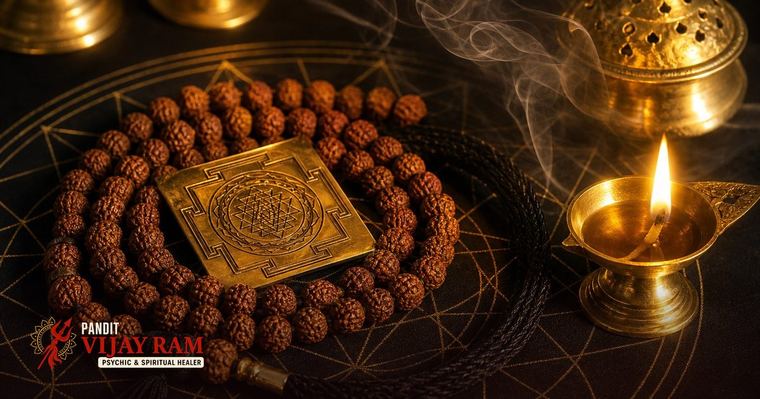
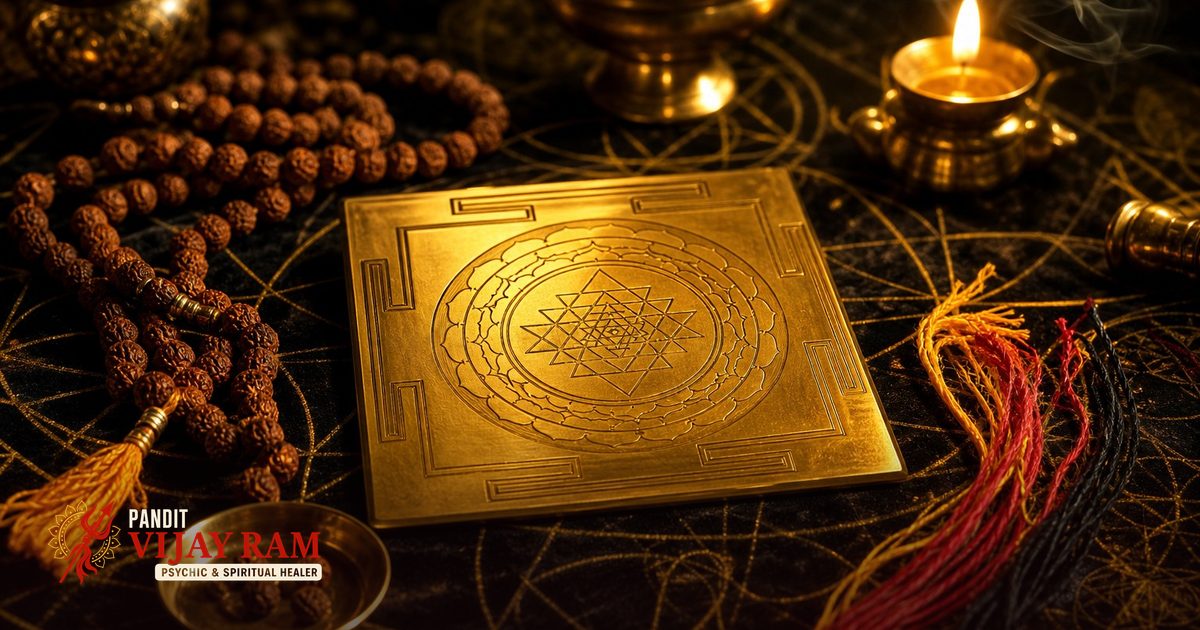
The traditional protective objects are the yantra (a geometric diagram, energised and placed in a specific direction), the rudraksha (chosen by mukhi count), the black thread or kalava, and gemstones — which should only be worn where the chart genuinely supports one.
An object with no practice attached to it does very little; an unsuitable gemstone can worsen the placement it was meant to help.
Yantras
A yantra is a geometric diagram associated with a particular energy — Shri Yantra for prosperity and general auspiciousness, Mahamrityunjaya Yantra for protection and healing, Navagraha Yantra for planetary balance, Kuber Yantra for wealth.
Three things determine whether it does anything:
- Energisation. An unenergised yantra is a printed diagram. It is consecrated through recitation over a set number of days.
- Placement. Direction and room, both specified. Generally the north-east for a home, and facing east or north.
- Maintenance. Kept clean, not behind clutter, not in a bathroom, not on the floor, and attended to regularly rather than hung and forgotten.
Rudraksha
| Mukhi | Traditionally associated with |
|---|---|
| 1 mukhi | Rare and correspondingly expensive; frequently counterfeited |
| 2 mukhi | Relationships and harmony |
| 5 mukhi | The general-purpose bead — suitable for almost anyone, and cheap |
| 6 mukhi | Focus, learning, expression |
| 7 mukhi | Wealth and relief from Saturn-related difficulty |
| 8 mukhi | Obstacle removal |
| 9 mukhi | Courage and protection; associated with Durga |
Five mukhi is the sensible default and costs very little. Anyone steering you toward a rare and expensive bead without first reading your chart is selling, not prescribing.
Threads
The simplest and most widely used protective object there is. Black thread on wrist or ankle against nazar; kalava (red and yellow) tied on the wrist during ritual; a thread energised through recitation for a specific purpose.
Cheap, safe, and effective within its scope. On a baby, loose and never around the neck. Replace when it wears through rather than repairing it.
Gemstones — read this before you buy
Gemstones are the most oversold item in this trade, by a wide margin. A stone strengthens a planet. Strengthening the wrong planet — one that is already causing difficulty in your chart — makes the situation worse, not better. Nobody should ever be prescribed a stone without a full chart reading, and nobody should be sold one by the person who prescribed it. Prices are also routinely inflated several times over.
Where a stone is genuinely indicated, you will be told which, what weight, which metal, which finger, and which day to first wear it — and then sent to buy it yourself from whoever you like. Nothing is sold at this practice, which removes the incentive to prescribe.
What none of these objects will do
- Work without a practice attached. The object marks the intention; the practice is the intention.
- Clear an existing affliction on its own. Objects protect; they do not remove.
- Replace medical treatment, or a difficult conversation, or paying a debt.
- Function while sitting in a drawer, which is where most of them end up.
How not to be overcharged
- Never buy from the person who prescribed it. That is the whole of the problem in one sentence.
- Ask why this specific object, from your specific chart. A real answer names a placement.
- Be sceptical of urgency. Nothing legitimate has to be bought today.
- Five mukhi rudraksha and black thread cost a few pounds. Start there.
- Get a second reading before spending significant money on a gemstone.
Why nothing is sold at this practice
Vijay Ram does not sell gemstones, yantras, threads or rudraksha. That is deliberate, and it is the single most useful thing to know when weighing anything a practitioner recommends.
A practitioner who sells what they prescribe has a direct financial interest in finding that you need something, and in finding that you need an expensive version. Almost everyone in this field does both, and prices are routinely several times what the same item costs elsewhere.
Here you get a specification — which item, what weight, which metal, which finger, which day to begin — and you are sent to buy it yourself from whoever you like. Frequently the honest answer is that nothing is needed at all, and a daily practice and an act of charity will do more. That answer disappoints people who arrived expecting to be given something to buy, and it is still the right one.
If someone has told you that you need a particular stone, get a second reading before you spend anything. See gemstone consultation — nothing is sold here, which is rather the point.
- yantra
- rudraksha
- gemstones
- amulets
- protection
Last reviewed 13 August 2026 by Vijay Ram, 33 New Broadway, Ealing, London W5 5AH. Call +44 7766 402133 for a private consultation.
Frequently asked questions
Do I need to buy anything to be protected?
No. The daily practice, threshold discipline and conduct do most of the work, and they cost nothing. Objects are supplementary.
Where should a yantra be placed?
Generally the north-east of the home, facing east or north, at eye level or above, clean and unobstructed. Never in a bathroom and never on the floor.
Is an unenergised yantra useless?
It is a diagram. Energisation through recitation over a set period is what the tradition regards as making it active.
Do you sell gemstones or yantras?
No. Where one is indicated you are told exactly what to get and left to buy it yourself. That is deliberate.
Not sure what you are dealing with?
Describe what has been happening. You will get an honest reading of whether this is spiritual, circumstantial or medical — with no pressure and no charge for the first conversation.
33 New Broadway, London W5 5AH, United Kingdom · Open 7 days · 9:00am–9:30pm