If you find something at your threshold: do not touch it with bare hands, do not bring it indoors, and do not burn it inside.
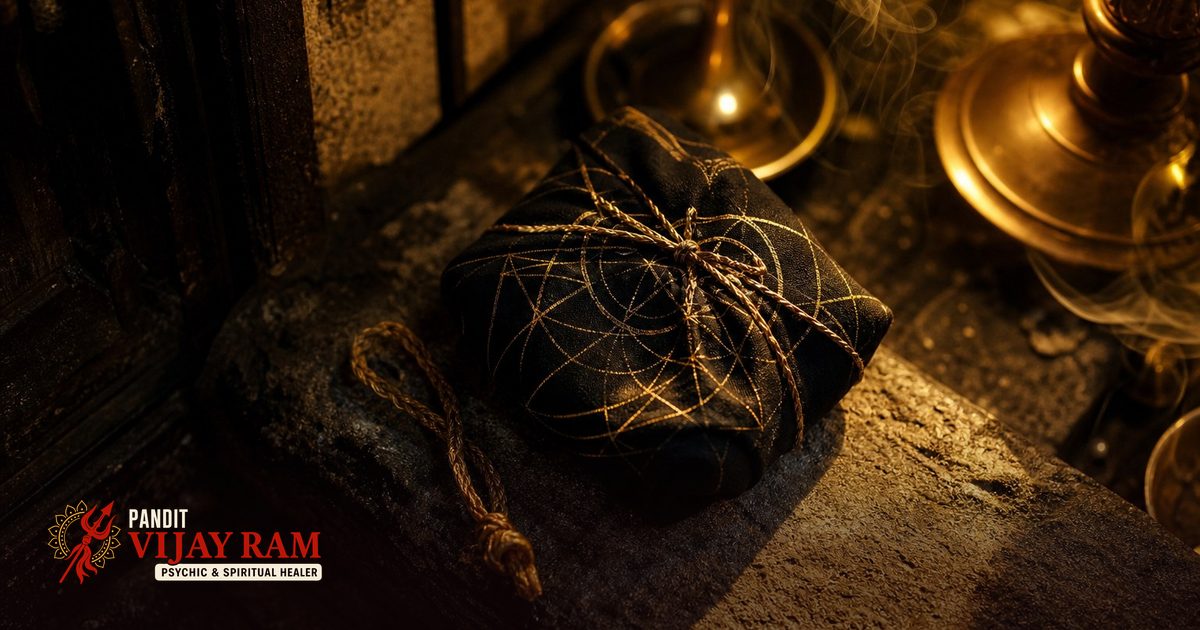
Photograph it where it lies and get advice. Most of what people find is ordinary debris. The items traditionally treated as significant are knotted thread or hair, buried cloth bundles, ash or coloured powder at a threshold, lemons stuck with pins or nails, and written paper wrapped in fabric.
What to do in the first ten minutes
- Leave it exactly where it is.
- Photograph it from three angles, with something for scale, and note the exact spot.
- Do not touch it with bare hands. Not because it will hurt you — because if it turns out to be nothing, you have handled someone’s rubbish, and if it is something, you should not be moving it yourself.
- Do not bring it into the house, and above all do not burn it indoors. Some materials produce genuinely harmful smoke.
- Keep children and pets away from the spot.
- Call for advice before you do anything else.
Objects traditionally linked to black magic
| Item | Traditional reading |
|---|---|
| Knotted thread — black, red or mixed | Binding work. The knots are the mechanism, and the number is read |
| Human hair or nail clippings | A personal link to the target. Considered among the more serious finds |
| Cloth bundle, buried or wedged | The commonest physical form — contents vary widely |
| Ash, turmeric or vermilion at a threshold | Ritual residue placed at the boundary point |
| Lemon or lime stuck with pins or nails | Well-known and widely recognised; usually placed openly to be found |
| Paper with writing, wrapped in fabric or foil | Written work — sihr and taweez traditions |
| A photograph of you or your family, damaged or defaced | Direct targeting. Rare and taken seriously |
| Eggs, coconuts or small clay pots at a boundary | Offering or transfer rituals |
Objects found at your door that are almost always nothing
The great majority of what gets photographed and sent in is ordinary:
- Builders’ offcuts, cable ties, cement bags and packing material.
- Children’s lost toys, party debris, deflated balloons.
- Birds’ nesting material, which frequently includes hair and thread — this is the single commonest false alarm.
- Fox and cat activity, which scatters startling things across a garden.
- Rubbish blown from a neighbour’s bin.
- Lemon and chilli hung at a shop door — that is protection, put there by the owner.
Where things are traditionally placed
Placement follows a logic: the point where you cross a boundary daily.
- Under or beside the doormat.
- Buried just inside a gate or at a garden boundary.
- Wedged in a doorframe, a letterbox or a gatepost.
- In a plant pot beside the front door.
- Under a vehicle, or in a wheel arch.
- At the entrance to a shop, usually beside rather than in the doorway.
Correct disposal
Where an item is assessed as significant, it is removed properly — handled with a cloth or gloves, taken away from the property, and disposed of in running water or buried at a distance. Not in your own bin, which keeps it on your land, and not burned indoors.
The threshold is then cleaned with salt water and the entrance re-marked. Removing an item without clearing the point it sat on is half a job.
If you think someone is coming onto your property
Trespass, criminal damage and harassment are police matters. If someone is repeatedly entering your property, report it on 101, or 999 in an emergency, and consider a doorbell camera. Spiritual protection is worth having; it is not a substitute for evidence and a crime reference number.
What actually arrives on WhatsApp
Photographs of found objects reach this practice most weeks, and it is worth saying plainly what the ratio looks like.
The overwhelming majority are nothing. Birds’ nesting material is the single commonest — it contains hair, thread and fabric, it turns up under hedges and in gutters, and it looks exactly like what a frightened person expects to find. After that: builders’ offcuts, damp-proof membrane, packing material, and things a fox has dragged across a garden.
Vijay Ram will tell you that on the phone, for nothing, usually within the hour. A good proportion of the people who send a photograph never need anything else, and that is a perfectly good outcome. Send the picture before you move it, and before you spend a night worrying about it.
Send the photographs before you move anything. Assessment of what has been found, and its correct disposal, is part of black magic removal.
- black magic
- objects
- threshold
- taweez
Last reviewed 19 July 2026 by Vijay Ram, 33 New Broadway, Ealing, London W5 5AH. Call +44 7766 402133 for a private consultation.
Frequently asked questions
I already picked it up. Have I made it worse?
No. Wash your hands, put it outside the property, and get advice. Nothing irreversible happens from handling an object.
Can I just throw it in the bin?
Your own bin keeps it on your property, which defeats the purpose. Better to have it assessed first; if it is nothing, ordinary disposal is fine.
Should I confront my neighbour?
No. You have no evidence of who placed anything, and an accusation you cannot support makes your living situation considerably worse.
Can you tell from a photograph?
Often enough to say whether it warrants attention. Send clear photographs from a few angles on WhatsApp to +44 7766 402133.
Not sure what you are dealing with?
Describe what has been happening. You will get an honest reading of whether this is spiritual, circumstantial or medical — with no pressure and no charge for the first conversation.
33 New Broadway, London W5 5AH, United Kingdom · Open 7 days · 9:00am–9:30pm