Cleanse a new home before the furniture arrives and before anyone sleeps there: find out the property’s history, air it fully, wash the thresholds with salt water, carry camphor clockwise through every empty room, and where possible perform griha pravesh at a muhurat calculated from the householder’s chart.
An empty house is far easier to clear than a furnished one, and doing it now avoids clearing a problem later.
Damp, poor ventilation, carbon monoxide and faulty wiring cause many of the same effects and must be ruled out first — a carbon monoxide alarm costs less than any consultation. Call 999 if you suspect a gas leak. No outcome is guaranteed.
First, find out what happened here
Ask the estate agent directly. Ask the neighbours, who will usually tell you far more. Look at how long it has been on the market and how many times it has changed hands.
What you are listening for: a death in the property, a long final illness, a marriage that ended there, a repossession, a business that failed, or an occupant who was in serious distress. None of it is a reason not to buy. All of it changes what the cleansing needs to be.
The cleansing, while the house is empty
- Clean it properly first — a builders’ or deep clean, including inside cupboards.
- Open every window for at least an hour. A house that has stood empty needs air more than anything.
- Salt water on every threshold, starting at the front door and working clockwise. Throw the water away outside the property.
- Rock salt in the corners of every room, left for three days, then disposed of outside.
- Camphor clockwise through every room, including the loft, the garage and under the stairs, starting and ending at the front door.
- Loban as well, where the property has a heavy history.
- Recite as you go — aloud, in whatever tradition is yours.
Griha pravesh — the housewarming
The traditional entry ceremony, performed before the family first lives in the property. It is held at a muhurat calculated from the householder’s birth chart, which is why it needs to be arranged weeks ahead rather than fitted around the removal van.
Traditionally avoided: entering during an inauspicious period, in the month of Shraddha (Pitru Paksha), or after dark. Traditionally favoured: morning entry on an auspicious day, with the household entering together.
Details under house and business cleansing.
The first entry
- Enter with the right foot first.
- Carry in, in this order: a vessel of water, milk, rice or grain, and something sweet.
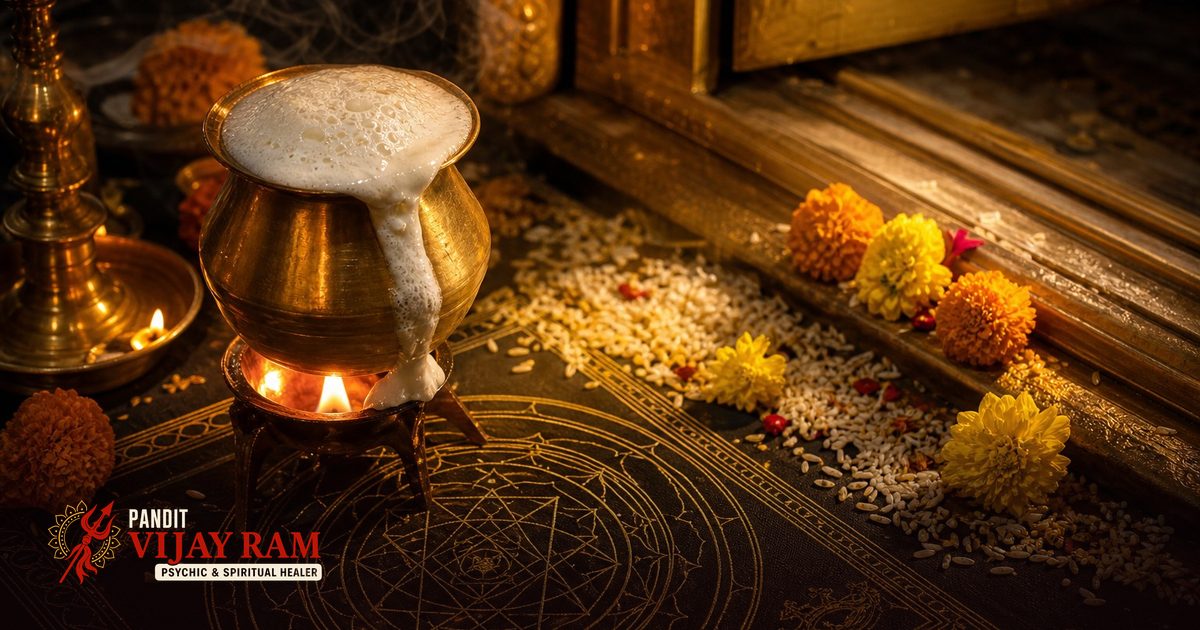
- Boil milk in the kitchen until it overflows. The oldest and simplest of all housewarming rites, and it takes five minutes.
- Light a lamp at the entrance and keep it lit for the first evening.
- Cook something in the house on the first day, however simple.
- Do not move in on a day when the household is arguing. Wait a day.
Things worth checking that are not spiritual
- Damp. Behind furniture on external walls, in the corners of bedrooms, under sinks.
- Ventilation. Extractors that work, trickle vents that open, windows that actually open.
- A carbon monoxide alarm. Fit one before you move in.
- Light. Which rooms get sun and when. It determines where the bedrooms and the desk should go.
- Sleeping direction. Head to the south or east is the traditional preference; north is avoided.
- The entrance. Well lit, clear, and with somewhere for shoes that is not the doorway itself.
- new home
- griha pravesh
- house cleansing
- moving in
Last reviewed 15 August 2026 by Vijay Ram, 33 New Broadway, Ealing, London W5 5AH. Call +44 7766 402133 for a private consultation.
Frequently asked questions
Do I need a priest for griha pravesh?
The full ceremony is traditionally performed by a priest or an astrologer, at a calculated time. The simple version — salt, camphor, right foot first, boiling milk and a lamp — you can do yourself and it is genuinely worth doing.
What if I have already moved in?
Do the full cleansing now. It is more work with furniture in place but it is entirely effective. Concentrate on the entrance, the bedrooms and any room that feels wrong.
Does this apply to a rented flat?
Yes, and arguably more so — rental properties turn over frequently and accumulate a great deal. Nothing permanent is installed, so there is no tenancy issue.
Someone died in the house. Should I still buy it?
It is not a reason to walk away. Almost every older property in Britain has had a death in it. It simply means a proper cleansing before you move in rather than a quick one.
Not sure what you are dealing with?
Describe what has been happening. You will get an honest reading of whether this is spiritual, circumstantial or medical — with no pressure and no charge for the first conversation.
33 New Broadway, London W5 5AH, United Kingdom · Open 7 days · 9:00am–9:30pm