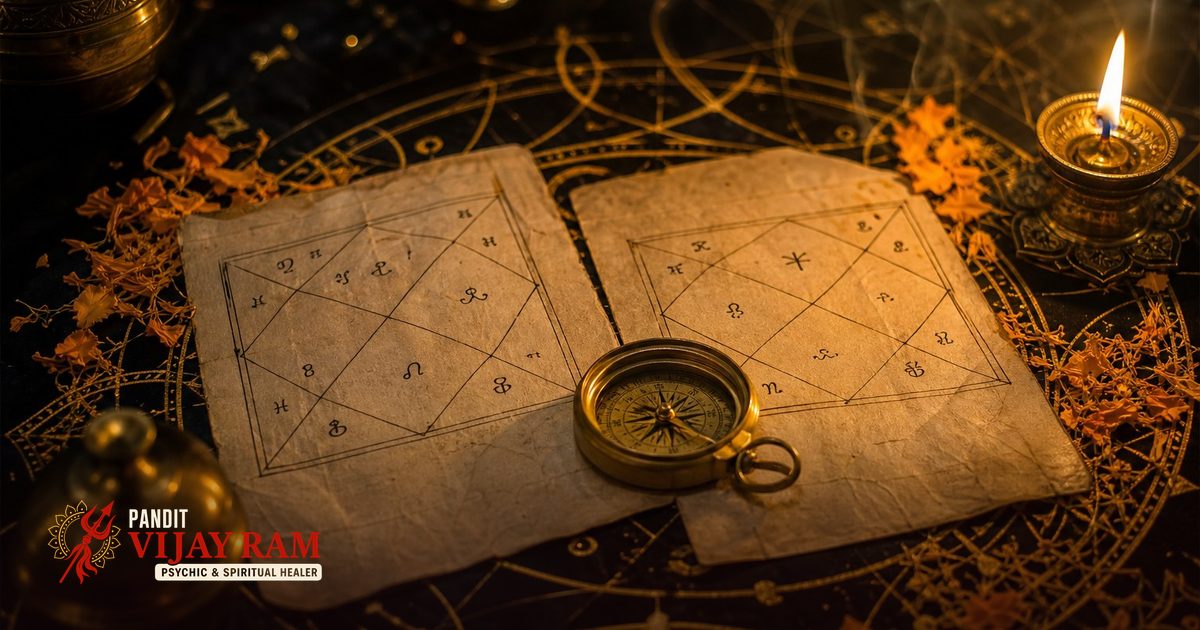
Kundli matching compares two birth charts across eight koota, scored out of 36 gunas. Eighteen or above is conventionally workable, below eighteen invites a closer look.
The score is a starting point, not a verdict — Mangal dosha, the seventh house and the running dasha matter more than the number.
A reading describes tendencies and timing; it does not predict fixed events and it is not medical, legal or financial advice. You will be told plainly when a chart does not support a conclusion. No outcome is guaranteed.
What kundli matching actually compares
Kundli matching, or Guna Milan, sets two birth charts side by side and scores eight separate compatibilities called koota. Each carries a different weight, and they add up to 36. The system is old, it is specific, and it is far more often quoted than understood.
| Koota | Points | What it looks at |
|---|---|---|
| Varna | 1 | Working temperament and outlook |
| Vashya | 2 | Mutual influence and give-and-take |
| Tara | 3 | Health and fortune of the pairing |
| Yoni | 4 | Physical and intimate compatibility |
| Graha Maitri | 5 | Mental affinity and friendship |
| Gana | 6 | Temperament: nature and disposition |
| Bhakoot | 7 | Household prosperity and wellbeing |
| Nadi | 8 | Constitution and lineage |
Because Nadi alone is worth eight points and Bhakoot seven, a single mismatch in either can drop a score by a quarter. That is the arithmetic behind most of the alarming numbers families are shown.
What the score means, and what it does not
Eighteen out of 36 is the figure most astrologers use as a working threshold. Above it, the match is conventionally considered viable. Below it, the chart deserves a closer reading rather than a refusal.
The honest position is this: the score is a summary, and summaries lose information. Two charts can score 28 and still carry a badly afflicted seventh house in both, which is where marriage itself is read. Two others can score 16 because of a single Nadi clash while every other indicator of a settled household is sound. Vijay Ram reads the seventh house, its lord, the position of Venus and Jupiter, and the dashas each person is running before saying anything at all about the total.
Mangal dosha, and why it is cancelled more often than it is applied
Mangal dosha — Mars in the 1st, 2nd, 4th, 7th, 8th or 12th house — is the single most common reason a family is told a match is impossible. It is also the condition most often cancelled outright.
Cancellation applies in a long list of ordinary situations: when both charts carry it, when Mars is in its own sign or exalted, when Mars is aspected by Jupiter, when the person is past a certain age, and several more. A great many people described as manglik are, on a full reading, nothing of the kind. If you have been told this and no cancellation was even discussed, the reading was not finished. There is a fuller explanation on the Mangal dosha page.
When a low score is worth overriding
Families sometimes arrive having already decided, and want to know whether the chart forbids it. It rarely does. A low guna score with sound seventh houses, compatible dashas and no serious affliction is a match that will need patience in specific years, not a match that should be abandoned.
What is not honest is telling a couple a number can be fixed by a fee. Nothing performed by anyone changes two birth charts. What a remedy can reasonably address is the timing of the wedding and the specific planetary period that looks difficult, which is a different claim altogether.
What to bring to a matching consultation
Both birth dates, both birth times as accurately as they can be established, and both birth places. Birth time is the part people guess at, and it is the part that matters most: twenty minutes can move the ascendant into the next sign and change the reading of the seventh house entirely.
If a birth time genuinely is not known, say so rather than estimating. There are rectification methods, and an honest 'we cannot read this reliably' is better than a confident answer built on a guess.
- kundli matching
- guna milan
- marriage compatibility
- London
Last reviewed 24 August 2026 by Vijay Ram, 33 New Broadway, Ealing, London W5 5AH. Call +44 7766 402133 for a private consultation.
Frequently asked questions
What is a good score in kundli matching?
Eighteen or more out of 36 is the conventional threshold, and 25 or above is considered strong. But a score is a summary of eight separate factors, and a high total can still hide an afflicted seventh house. The number should never be the only thing you are shown.
Can a marriage work if the gunas do not match?
Frequently, yes. A low score points to areas that will need conscious effort; it is not a prohibition. Many settled marriages would have scored poorly on paper. The charts should be read properly before anyone treats a number as a refusal.
Is Mangal dosha a reason to cancel a match?
Usually not. Mangal dosha is cancelled in a long list of ordinary circumstances — when both charts carry it, when Mars is strong or aspected by Jupiter, and several others. Ask whether cancellation was checked before accepting the diagnosis.
Do you need exact birth times for both people?
As accurate as you can get. Twenty minutes can shift the ascendant and change which house each planet occupies. If a time is genuinely unknown, say so — that is a better basis for a reading than a confident guess.
Not sure what you are dealing with?
Describe what has been happening. You will get an honest reading of whether this is spiritual, circumstantial or medical — with no pressure and no charge for the first conversation.
33 New Broadway, London W5 5AH, United Kingdom · Open 7 days · 9:00am–9:30pm