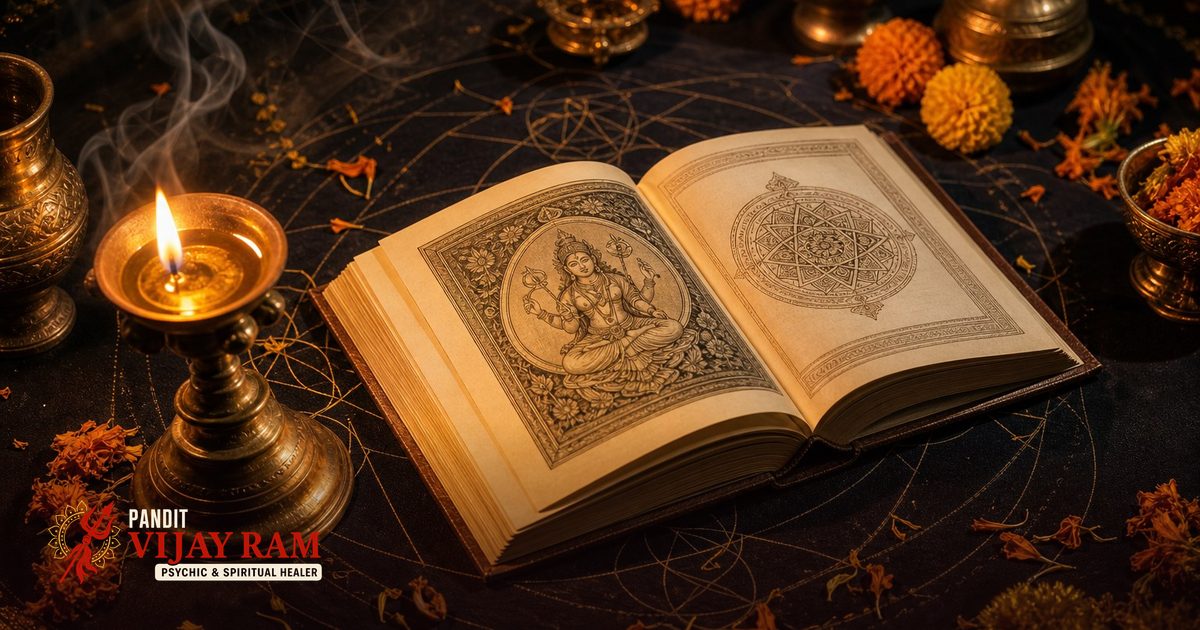
The Hanuman Chalisa is a forty-verse hymn, and it is the single most frequently prescribed remedy in Vedic practice.
It is given for fear, obstruction, negative influence, Saturn-related difficulty and Mangal dosha — and it is prescribed so often partly because it suits so many situations and partly because, at seven or eight minutes, people actually keep it up.
Why the Hanuman Chalisa is prescribed so often
Four reasons, and the last is the most practical.
- Breadth. Hanuman is associated with courage, protection, obstruction removal and service — which covers most of what people arrive with.
- Saturn. There is a strong traditional association between Hanuman worship and relief from Shani-related difficulty, which is why it is the standard first prescription during Sade Sati.
- Mars. Hanuman is linked to Mangal, so it is also the usual prescription where Mangal dosha is genuinely present.
- It is seven minutes long. A remedy nobody keeps is not a remedy. An elaborate hour-long practice gets abandoned by day nine; this one survives a real week.
When it is given
| Situation | Usual form |
|---|---|
| Fear, anxiety, a sense of being watched | Once daily, aloud, at a fixed time |
| During Sade Sati or a Shani dasha | Daily, with Saturday observance and charity |
| Mangal dosha | Tuesdays, often 7 or 11 repetitions |
| After a clearing, as protection | Daily for the ninety-day protection period |
| Obstruction — work, court, disputes | Tuesday and Saturday, with Sundarkand where indicated |
| General household protection | Once daily, and 11 times on Tuesdays |
How to actually recite the Hanuman Chalisa
- Same time every day. The regularity does more work than the length. Morning after washing is traditional; the practical answer is whatever hour you will genuinely keep.
- Aloud, or in a whisper. Particularly for fear — hearing your own voice steadily is part of the effect.
- Sitting still. Not while driving, not while scrolling.
- Face east or north if convenient. Not a requirement.
- Forty days minimum before judging whether anything has changed.
- If you miss a day, resume. Do not restart, do not double up, and do not use it as a reason to stop.
Learn the pronunciation from a recording. Sincere recitation with imperfect Awadhi is worth far more than perfect pronunciation attempted twice and abandoned.
Tuesday and Saturday
Both are traditionally associated with Hanuman — Tuesday through Mars, Saturday through the Saturn connection. Those are the days for a fuller observance: more repetitions, a lamp lit, and an act of feeding or charity.
That last element is worth keeping. Across the whole tradition, the remedies that most reliably change people are the ones that involve giving something away, and pairing recitation with a weekly act of feeding is the standard form.
If it is not your tradition
Clients of every faith and none are looked after here, and nobody is asked to recite anything that sits uncomfortably with their own belief.
Where the Hanuman Chalisa would not suit, the structure is what transfers: the same words, at the same time, every day, aloud, for forty days, paired with a weekly act of giving. Use your own tradition’s protective prayer, or none at all — the discipline is doing a great deal of the work.
Recitation is one layer, not the whole of it. On its own it will not clear a genuine affliction, and it is not a substitute for medical care, for settling a dispute, or for the practical action a situation requires. If you are struggling with anxiety or low mood, please also speak to your GP.
The remedy people actually keep
If you asked Vijay Ram which remedy he has prescribed most often over forty years, this would be it — and the reason is more practical than mystical.
It takes seven or eight minutes. An elaborate hour-long practice, however well suited to a chart, gets abandoned by the ninth day, and a remedy nobody keeps is not a remedy. The Chalisa survives a genuinely bad week, which is when it matters.
It also suits an unusually wide range of situations — fear, obstruction, Saturn difficulty, Mangal dosha — and carries no restrictions, so it can be given to almost anyone. Where a client’s own tradition is different, Vijay Ram keeps the structure and changes the words: same prayer, same time, every day, aloud, for forty days, paired with a weekly act of giving.
Which recitation suits your chart, and for how long, is set at the reading — see spiritual protection.
- hanuman chalisa
- mantra
- protection
- saturn
- remedies
Last reviewed 18 August 2026 by Vijay Ram, 33 New Broadway, Ealing, London W5 5AH. Call +44 7766 402133 for a private consultation.
Frequently asked questions
How many times should I recite it?
Once daily is the standard. Seven or eleven times on Tuesdays where a stronger observance is indicated. Once daily kept for a year beats eleven times done for a fortnight.
Does it have to be in the morning?
Morning after washing is traditional, but the practical answer is whatever fixed time you will actually keep every day. Consistency matters more than the hour.
What if my pronunciation is poor?
It matters far less than people fear. Learn from a recording, do your best, and keep going. Sincerity and consistency are worth more than perfect Awadhi.
Can I recite it if I am not Hindu?
You are welcome to, and many do. If it does not suit, use your own tradition's protective prayer in the same structure — same words, same time, daily, for forty days.
Not sure what you are dealing with?
Describe what has been happening. You will get an honest reading of whether this is spiritual, circumstantial or medical — with no pressure and no charge for the first conversation.
33 New Broadway, London W5 5AH, United Kingdom · Open 7 days · 9:00am–9:30pm