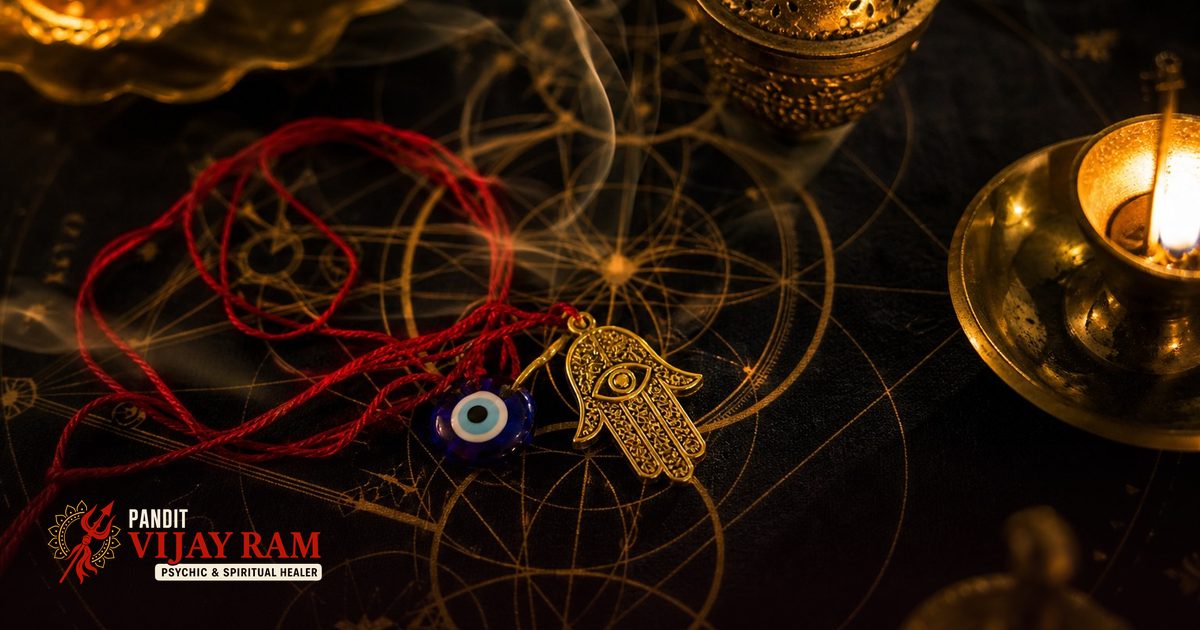
Nearly every culture has a version of the evil eye — nazar in South Asia and the Middle East, mal de ojo in the Spanish-speaking world, ayin hara in Jewish tradition, matiasma in Greece, drishti in South India.
The shared idea is that concentrated envious attention has weight. Strikingly, the remedies converge too: something circled around the person, something burned, and something blue or black worn.
Protective practice is not a substitute for medical or psychological care. If symptoms are physical or persistent, see your GP or call NHS 111. If a child is at risk, Childline is 0800 1111. No outcome is guaranteed.
The evil eye under many names
| Tradition | Name | Characteristic protection |
|---|---|---|
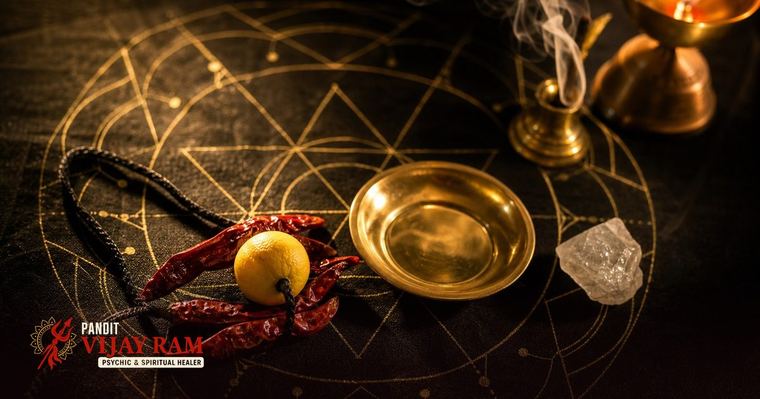
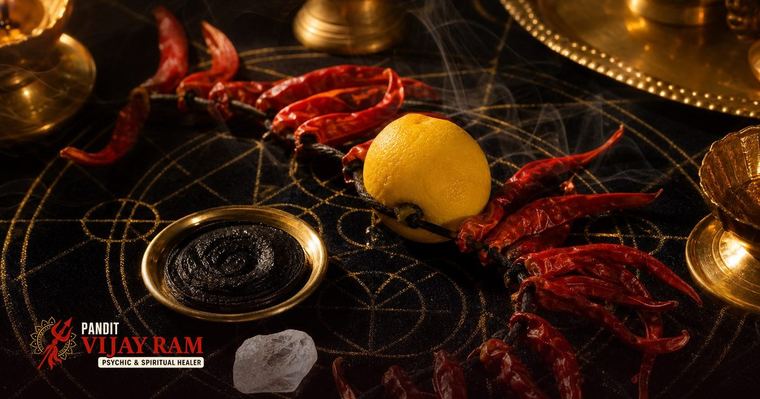
| South Asia | Nazar, buri nazar, drishti | Black thread, kajal mark, lemon and chillies, salt and chilli circled and burned |
| Middle East, Turkey | Nazar boncuğu | The blue glass eye bead |
| Greece | Matiasma | The blue mati charm; olive oil dropped in water to test |
| Italy | Malocchio | The cornicello horn; oil and water divination |
| Spain, Latin America | Mal de ojo | An egg passed over the person, then broken into water and read |
| Jewish tradition | Ayin hara | Red thread; discretion about good fortune |
| North Africa | — | The hamsa hand |
| West Africa | — | Worn charms and protective marks |
Three remedies that keep recurring
What is striking is not that many cultures have the belief. It is that the remedies take the same three forms.
- Something circled around the person and then destroyed. Salt and chilli in India, an egg in Mexico, alum in Turkey and Iran. Something takes the influence on and is then removed.
- Something burned, and the result read. The pungency of chilli smoke, the shape molten alum takes, the pattern oil makes in water. A diagnostic step as well as a remedy.
- Something worn, usually blue or black. The blue bead, the black thread, the kajal mark, the red string. Placed to catch attention before the person does.
That third one has a plain reading available: a bright marker draws the eye to itself. Whether you take that literally or symbolically, the design is the same everywhere.
What every tradition agrees on
- It attaches to what is going well — a new baby, a wedding, a new house, visible success.
- It is usually unintentional. Almost no tradition treats it as an attack. The person who caused it typically loves you.
- Children are most exposed, because they attract the most concentrated admiring attention.
- Discretion is the main protection. Every tradition counsels against announcing good fortune widely — which is worth pausing on in the age of social media.
- It is the mildest of the negative influences and clears in days, not weeks.
Why evil eye is the most over-diagnosed complaint
Because it is the single most over-diagnosed condition in this trade.
Nazar clears in one to three days with materials costing a few pounds. Black magic takes weeks of proper work. The financial gap between the two diagnoses is enormous, and there is a strong commercial incentive to diagnose upward.
If someone quotes you a multi-week programme and a large fee for what is plainly nazar — a run of small misfortunes starting right after good news was shared — you are being overcharged. See evil eye symptoms and remedies.
Why the same cases arrive in five vocabularies
West London is unusual in how many traditions sit within a few miles of each other, and it shows in a week’s appointments at 33 New Broadway.
A Punjabi family from Southall describes nazar. A Turkish client uses nazar boncuğu. A Greek Cypriot from Ealing calls it matiasma. A Somali family says il. A Ghanaian client from Croydon describes something closer to a directed curse. Vijay Ram has read all five in the same fortnight.
The presentations are near enough identical: a run of small misfortunes beginning immediately after something went visibly well, plus fatigue that arrives in company. The remedies differ in material and the clearing is adapted to whatever sits comfortably with the client’s own tradition. The diagnostic question does not change at all.
Whichever tradition the vocabulary comes from, the clearing is quick and inexpensive — see evil eye and nazar removal.
- evil eye
- nazar
- mal de ojo
- culture
- protection
Last reviewed 3 August 2026 by Vijay Ram, 33 New Broadway, Ealing, London W5 5AH. Call +44 7766 402133 for a private consultation.
Frequently asked questions
Does it matter which tradition's remedy I use?
Use the one that belongs to you. The forms converge, and a remedy you understand and will actually keep is worth more than a borrowed one you half-believe.
Why is the protective charm always blue?
Not always — black, red and blue all appear. The common feature is a bright marker positioned to catch the eye before the person does.
Is the evil eye the same as black magic?
No. Nazar is unintentional, involves no ritual and clears in days. Black magic is deliberately performed, targets one area of life and takes weeks. Confusing the two is expensive.
Can I use a hamsa or mati if I am not from that culture?
Respectfully, yes — these objects have crossed cultures for centuries. But the protection in every tradition is mostly discretion and practice rather than the object.
Not sure what you are dealing with?
Describe what has been happening. You will get an honest reading of whether this is spiritual, circumstantial or medical — with no pressure and no charge for the first conversation.
33 New Broadway, London W5 5AH, United Kingdom · Open 7 days · 9:00am–9:30pm